Years of credential-harvesting and ransomware campaigns have exposed a hard truth in network security: the traditional network perimeter is no longer a boundary you can rely on. For a long time, SSL VPNs were the standard way to give staff remote access. Today, automated credential stuffing, brute forcing, and fast-moving ransomware have turned the public VPN gateway into a structural liability.
That is why Spot On Tech disabled SSL VPN across the networks we manage and standardized on Zero Trust Network Access (ZTNA). Remote access for the businesses we protect no longer depends on a public gateway that attackers can see and hammer around the clock.
The core flaws of traditional SSL VPNs
The architecture of a standard SSL VPN builds three hard-to-fix weaknesses into a network.
1. Implicit trust
VPNs use a castle-and-moat model. Anyone outside is treated as untrusted, but anyone who presents a valid password at the gateway is trusted completely. Once past that single checkpoint, a user inherits broad access to the internal network. If an attacker steals a password through a credential-harvesting campaign, they inherit that same trust.
2. Broad lateral movement
When someone connects over an SSL VPN, they are placed directly on the network, usually with an address on a broad corporate subnet. That lets an attacker who compromises a single VPN account move sideways across the infrastructure, mapping Active Directory, locating backup servers, and staging environment-wide ransomware.
3. A public attack surface
An SSL VPN gateway has to sit openly on the public internet to accept connections. That makes it a permanent, visible target. Automated scanners and exploit kits probe these portals around the clock, hunting for misconfigurations, unpatched firmware, or weak administrative endpoints.
What is ZTNA?
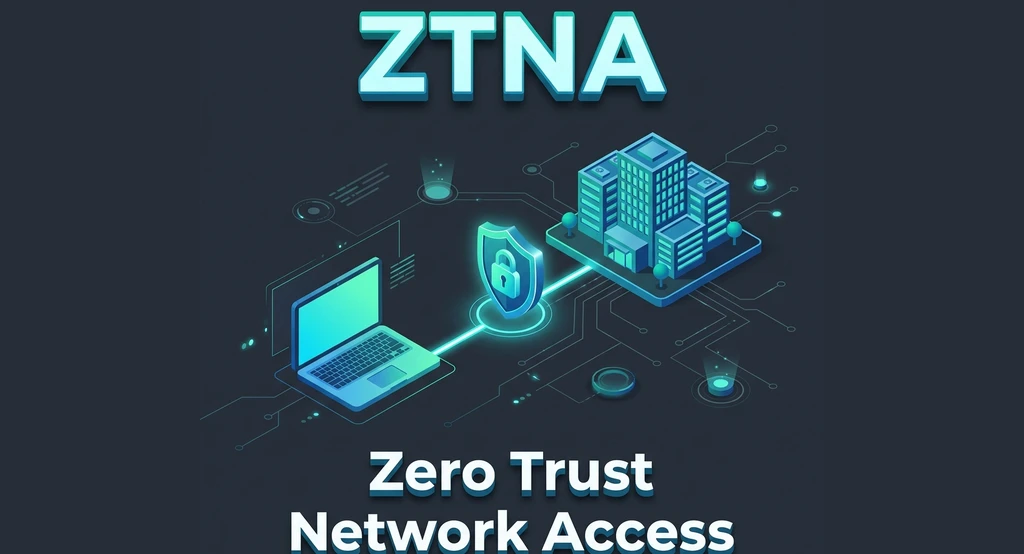
Zero Trust Network Access drops the idea of a trusted internal perimeter entirely. Instead of guarding a perimeter, it secures each connection on the principle of "never trust, always verify." Rather than placing a user onto a network subnet, ZTNA creates a secure, isolated connection between an authenticated user and the specific application they are allowed to use.
In practice the path is simple: the remote user connects to a trust broker, the broker verifies identity and device posture continuously, and only then is the user connected to the one application they are authorized for. Nothing else on the network is visible to them.
How ZTNA removes the payoff from stolen credentials
- Application-level microsegmentation. Users never touch the underlying network. If someone is authorized for one internal application, that is all they can reach. There is no lateral visibility, which neutralizes an attacker's ability to pivot to other servers.
- Continuous verification. ZTNA does not rely on a single login event. It keeps checking the session context, including user behavior, location, and device posture such as whether an endpoint firewall or antivirus is running. If the context changes mid-session, access is revoked.
- Outbound-only connections. ZTNA uses secure outbound connectors instead of public inbound listening ports. With no public IP address listening on the open web, internal applications become invisible to external scanners and automated campaigns.
SSL VPN versus ZTNA at a glance
| Operational feature | Legacy SSL VPN | Modern ZTNA |
|---|---|---|
| Access model | Implicit trust, authenticate once | Zero trust, continuous contextual checks |
| Network visibility | Broad subnet access and lateral routing | Microsegmented, one application at a time |
| Attack surface | Publicly exposed inbound listening port | Cloaked behind outbound connectors |
| Traffic routing | Central backhaul that creates bottlenecks | Direct-to-application routing |
Better security and better performance for hybrid teams
Moving off legacy VPNs is not only a security upgrade. Traditional VPNs force all remote traffic to backhaul through a central appliance before reaching its destination, which adds latency for every remote worker. For a business running Microsoft 365, cloud line-of-business apps, and a mix of in-office and remote staff, that bottleneck slows everyone down. ZTNA connects each user directly to the application they need, which shrinks the attack surface and improves day-to-day performance at the same time.
How we make the transition painless
Switching away from SSL VPN does not require a disruptive, overnight cutover. We adopt ZTNA in phases, starting with the most sensitive administrative portals and internal applications, then moving the remaining remote access off the VPN. For the clients we manage, that work is already done: SSL VPN is disabled, and remote access runs through ZTNA. In a world where passwords are bought, sold, and harvested at scale, removing the public perimeter is the most durable defense there is.
Ready to retire your SSL VPN?
If your business still relies on a public VPN gateway for remote access, we can help you move to a zero-trust model without disruption. Contact Spot On Tech to review your remote-access setup, or explore our cybersecurity services and our Single Point Of Tech™ approach.